
What the Streets Carried
In 1787, handweavers from the community of Calton went on strike in protest over a proposed wage cut of 20%. The East India Company had begun importing cheap muslins from the colonies, causing a drop in the price of Scottish cloth and, consequently, the wages of the workers. On September 3, police attempted to break the strike but were fought off with a barrage of missiles. A detachment of the 39th regiment of the army under Lieutenant Colonel Kellet was sent to assist and, without reading the riot act, opened fire on the crowd. Three of the weavers were killed instantly.
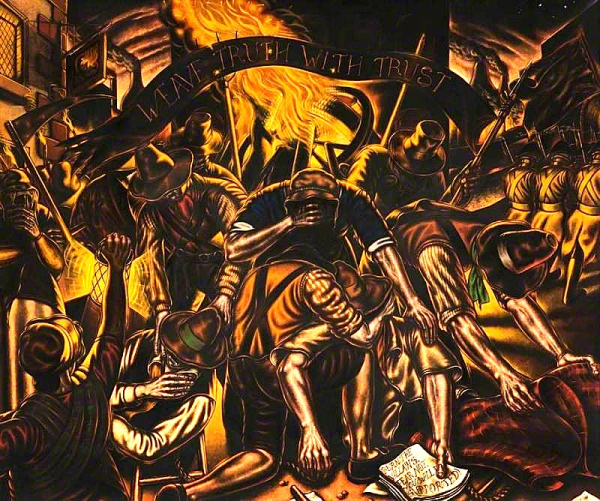
The Calton Weavers’ Massacre by Ken Currie, People’s Palace, Glasgow
My sister sent me a map.
Satellite image. Calton and Bridgeton, Glasgow. She had marked it with blue dots — streets where our ancestors lived. Dirt poor, many of them. The kind of people history records as a category rather than as individuals.
In the centre of the map, clearly labelled: Abercromby Street Burial Ground.
My grandparents’ marriage certificate records their address as 247 Moncur Street. My mother’s birth was registered at 80 Bellgrove Street. The family lived at 37 Annbank Street until they left for Wales.
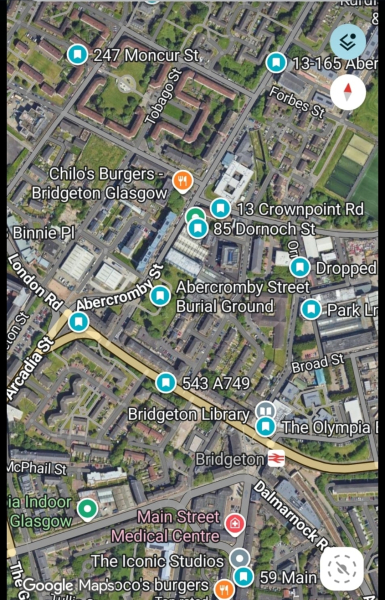
Every one of those addresses is in Calton.
The same ward. The same streets. The same community as the men in that burial ground.
What happened there
On the third of September 1787, soldiers opened fire on striking weavers in Calton. Six were killed or mortally wounded. Three died where they fell and were buried two days later in an unmarked plot — Lair 83, Calton Burial Ground, Abercromby Street. The plot lay unmarked for thirty-eight years. In 1825 a memorial slab was laid over it. The three who died of their wounds — Alexander Miller, James Page, James Ainsley — were buried elsewhere, by their families.
Six thousand people attended the funeral. The strike was subsequently broken by mass arrests.
Lieutenant Colonel William Kellet and Major Vere Poulett — the commanders who led the detachment — were awarded the Freedom of the City of Glasgow. The officers were treated to a lavish dinner at the Tontine Hotel at the city’s expense. The rank-and-file soldiers who fired into the crowd were given a new pair of shoes and stockings.
The weavers were placed in the ground and left there for 238 years.
That is not neglect. That is policy.
The people on those streets
My grandparents married across the sectarian divide that defined Glasgow in the 1930s. My grandmother Marion, Presbyterian. My grandfather James Archibald Watt, Catholic. In that city, in that era, that crossing carried real social cost. They paid it.
Bridgeton was the centre of the Orange Order in Scotland. The marches passed through those streets every summer. The boundary between communities was not abstract. It was daily, social, enforced — in employment, in housing, in who you were permitted to love.
They married anyway. Their address recorded as 247 Moncur Street.
They had children. My mother Agnes was born on 19th August 1931. Her birth registered at 80 Bellgrove Street — a street that connects directly to Abercromby Street, where three of the weavers lie.
Then June 1937.
James Simpson Watt died on the 15th of June at Glasgow Children’s Hospital. He was four years old.
Robert Watt was born on the 29th of June. He died on the 30th. He lived ten hours. His death certificate records no forename. He was one of fourteen babies who died in Glasgow Maternity Hospital that same day. Unnamed officially. But his mother Marion carried his name for fifty-one years. She died on the thirtieth of June 1988 — the same date she had buried him.
It was not until 2003 that we located him, in a common grave in Maryhill Cemetery. His name is now on his brother’s grave in St Peter’s, Dalbeth Cemetery.
Fifteen days. Two boys. Two hospitals. Two graves in Glasgow.
My grandparents buried a four year old son. Fifteen days later they held a baby who lived ten hours.
You don’t recover from that in the place it happened. You can’t walk those streets. You can’t stay in those rooms.
They left.
They took their surviving daughter — Agnes, six years old — and they went to North Wales.
In January 1940 Ian Watt died in Llandudno. Ten weeks old.
Three sons. Two countries. Three years.
What my mother carried out
Agnes was five years old when James died. Five when Robert died fifteen days later.
Old enough to know something catastrophic had happened to her family. Old enough to see what it did to her parents. Old enough to carry the atmosphere of that summer without having the words for it.
She left Calton at six with no conscious language for what she was leaving. No way to name 247 Moncur Street or Abercromby Street Burial Ground at the end of the road or what those streets had already absorbed across 150 years of poverty and loss and workers shot dead for asking to be treated fairly.
She arrived in North Wales and built a life from there.
She never spoke of the Calton Weavers. Almost certainly never knew that story formally.
She was formed on those streets nonetheless.
It showed up later. In the refusal of pity — not privately, visibly, as a matter of principle. In going to work and teaching other people’s children after my father died. In raising four children including a deaf son alone. In ‘you can’t do that with your ears’ — and then the fierce pride when I did.
She never called it resistance.
It was just how you lived.
But it was the same substance as what those streets had always produced. The same refusal to accept that the system’s account of you was the true account. Expressed in a different register, across a different century, by a woman who had no idea she was continuing anything.
The mathematics
238 years is not an oversight.
When a pattern holds across that timespan — suppress those who challenge power, erase their memory, honour those who enforce the violence — you stop calling it coincidence.
You call it architecture.
The weavers who died in 1787 connected to the 1820 Scottish Insurrection. That connected to Chartism. Chartism to the trade union movement. Each time the chain of memory broke, the next generation began again. At cost. Often in blood.
My grandparents crossed a line the city told them not to cross. Lost three sons across two countries. Carried a daughter out of Calton into a different life.
The streets accumulate what the institutions erase.
The theology
Every tradition that takes justice seriously has a theology of the martyr. Not the romantic hero. The witness. The Greek root — martys — simply means one who has seen and testified.
The paradox holds across traditions. The power of the witness grows through the attempt to suppress them. The institution that kills the voice cannot kill what the voice named.
The stones in Abercromby Street Burial Ground deteriorated. The institution let them deteriorate. And here we are in 2026, those words carved in stone, left to crumble, apparently erased — now in the mouth of The Tenementals, who played them at volume in Glasgow on May Day:
We’ll never swerve / we’ll steadfast be / we’ll have our rights / we will be free.
The system failed to erase them.
It always fails at that. Eventually.
Marion Watt carried Robert’s name for the rest of her life. That is the same impulse. The same refusal. Expressed in a mother’s memory rather than in stone.
What the rock band knows
Before the modern separation of academic knowledge from lived culture, history travelled through song. The bardic traditions of Celtic cultures. The oral Torah. The griot traditions of West Africa. Knowledge that matters to a community travels through the body, not just the page.
The Tenementals are not decorating history with music. They are restoring it to its natural medium. Playing those words at volume in a room full of people who still need those rights and are still not free enough.
Agnes would not have gone to that concert.
But she would have understood immediately — in her body, in whatever Calton had put there — what it was for and why it mattered.
The real legacy
The weavers didn’t win their strike. They lost it comprehensively. Three died instantly. Three died in hospital. The soldiers were honoured. The burial ground crumbled.
The movement they ignited outlasted every institution that tried to crush it.
This is what systems cannot model. Repression is supposed to produce compliance. Sometimes it produces the opposite. Six men who refused to be treated as less than human became the foundation of something the system that killed them could not outlast.
My grandparents refused the categories the city insisted on. Lost three sons. Left.
Carried a daughter out of those streets into a different life.
That daughter carried something she couldn’t name into everything she built after.
Her last words to my brother about me were that she didn’t know what to do about my illness. And that I had done it all on my own.
She carried that for sixty years. Quietly.
She lived until 2019.
The thread
I am sixty-six. Deaf. I write about systems that crush people who don’t fit the architecture. I have been filing that observation since I was seven years old — in classrooms, seminaries, council chambers, hospitals, courtrooms across five countries.
I did not choose that subject.
It chose me.
There is a map on my phone with blue dots on it. Sent by my sister. 247 Moncur Street. 37 Annbank Street. 80 Bellgrove Street. Abercromby Street Burial Ground.
The same ward. The same community.
James Simpson Watt. Robert Watt. Ian Watt.
These are real names. They deserve to be said.
The names that carried.
The Calton Weavers – Remember Glasgow’s Working Class Martyrs
Systems on Trial examines the machinery beneath the narrative: The System on Trial | Substack

We are supported only by our readers. We don't have corporate backers and we don't take advertising, so we rely entirely on your support.
Help to support independent Scottish journalism
Thank you, just thank you.
Thanks so much for that. I grew up in Glasgow and knew nothing about that history. Both parents had connections there. So much to learn and to honour.
The Tenementals – Magic!
Check out ” The Owl of Minerva ” ….candidate for song of the year last year!
https://youtu.be/FffdSfynIBc?is=d7eBCR11uDZQU7wP
Great writing. Thanks.
A powerful and necessary piece of writing. Thank you.
Did you know that a 10 minute walk from Moncur Street is the site of a famous educational institution, Barrowfield Free School/
Search Hidden Glasgow Website for +Barrowfield +Free +School
http://www.hiddenglasgow.com/forums/viewtopic.php?t=6011&__cf_chl_f_tk=ZCd6odPbvskbuHfmP3SL.5aDmnTZ3WEOsvM.6eX0HvU-1783274105-1.0.1.1-p_0b6q3DJLFmVPpWK3FqwSj8oLLxATrp2qN6CU.kDkk
Thanks Margaret
No Worries, John MacBeath at Jordanhill College of Education went on to become a Professor at Cambridge University, while the enterprise died in Glasgow – much like the heroism Calton Weavers. Never mind, it was great while it lasted. You may enjoy this Guardian article.
https://www.theguardian.com/education/2009/jan/13/john-macbeath-teaching-education-policy