
Early Days
Doug Chalmers and Seb Fischer look ahead to a possible, more progressive, Scottish polity. Can Labour grasp the Scottish nettle as Burnham settles into Number 10?
“Work as if you live in the early days of a better nation” is Alasdair Gray’s epigram, now engraved on a wall of the Scottish Parliament building.
The writer’s vision of a better nation may also drive Andy Burnham’s in his early days as Labour leader – but so far only for England.
For Scotland, early actions seem to herald the opposite.
Douglas Alexander has long been stuck in a pre-devolution concept of antipathy towards the SNP and towards Scotland’s distinctive Scottish politics. His re-appointment as Secretary of State for Scotland shows total disrespect.
When Alexander was first appointed by Keir Starmer, the First Minister John Swinney commented on Radio Scotland that Alexander had made life difficult for Scotland and that he had ‘soured’ relations between Scotland’s government and Westminster considerably. This had led to the haemorrhaging of what had been a ‘pretty constructive relationship’ during Ian Murray’s term – even though the latter was no lover of the SNP himself.
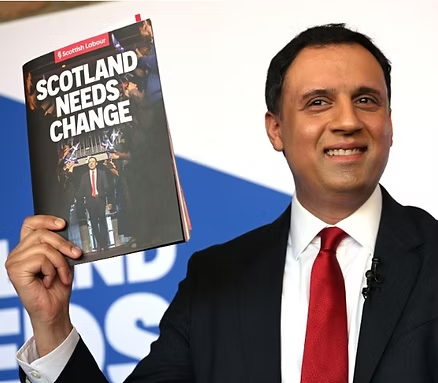
The appointment of Scottish Labour leader Anas Sarwar to the House of Lords adds insult to injury. Sarwar’s ‘elevation’ to the Lords can surely only strengthen the view amongst many – including those who voted Reform – that politicians are self-serving. Sarwar’s move cannot but damage Labour’s general standing with the Scottish public. The Lords are part of the archaic UK governance system which prompted Sarwar himself in 2022 to call for it “to be abolished, as it has no place in 21st Century politics”.
Labour’s Sisyphean task
Scottish Labour has a massive hill to climb if it is again to gain relevance in Scotland’s politics – an impossible task under Sarwar and other old Labour hacks. Despite massive donation funding – £553,635 in the last quarter of 2025, including £150,000 in December from the Easdale family, Labour’s eventual vote under Sarwar and Jackie Baillie’s – 16% on the overall list – was the lowest in its history since Scotland’s Parliament was established.
Sarwar’s ‘elevation’ and Alexander’s re-appointment seem to suggest real change isn’t coming soon.
Meanwhile the pro-independence parties remain strong, both in terms of their voting share and representation in Holyrood.
But before pro-independence voters console themselves that all it needs is one final push ‘if only’ the undemocratic denial of a second referendum can be removed, there is a lot to be questioned about the current state of the independence movement both in and out of Parliament. This is an area where sensible democrats in Scottish Labour should surely push for their own change of course in order to regain a position as part of the sensible pro-independence movement, for a different Scotland, and to be – in Gray’s words – ‘in the early days of a better nation’.
For genuine change, and to answer the question ‘what is independence for?’ the pro-independence parties need to rebuild a connection to the communities in Scotland which are increasingly in a state of economic emergency.
This is where the Labour tradition in Scotland can help, and in doing so, can help regain a solution to Labours ‘hollow core’ problem.
There needs to be real debate on Scotland’s economy. Under successive UK governments including Labour, Scotland has become increasingly de-industrialised and has lost control over key industries.
There was no real debate on the economy in the last election – and even the situation in Grangemouth where helpful legislation exists on a ‘just transition’ away from carbon fuels, there was a failure of an adequate response from the SNP government. Within Scottish Labour, where there is still an ambiguous approach to real action on climate change (as opposed to a blind re-exploiting of Scotland’s undoubted fossil reserves), the ‘blame game’ seemed to trump united action of the kind which could have had an impact.
Last year’s Fraser of Allander Institute’s report also indicates that there are still key structural issues with Scotland’s economy which need solved if our level of public spending can be properly resourced. Scottish Labour’s response to this has to be better than simply saying Scotland cannot afford independence. However, the SNP’s response cannot be to ignore that a question and problem does actually exist.
On democratisation, there is still a huge gap between the centralist approach of Scotland’s parliament and the enabling culture of decentralisation where power could be further devolved to communities. Despite its criticism of the SNP this is not an area where Labour has a great record either.
Having said this, Labour in some areas has been promoting community wealth creation and ’15 minute neighbourhoods’ – which could be one aspect of bringing power downwards.
Neither can the problem be simply solved by the imposition of Manchester-like Mayors. Mike Danson’s recent work, again reported by Bella Caledonia, indicates that the Manchester Mayoral process may have helped the region to some extent but it did not particularly empower the individual boroughs in the region.
A different Scotland by 2033?
Let us fast forward our imagination to a currently unrecognisable but possible scenario: Scotland in 2033.
Two years earlier, in the 1 May 2031 Scotland Parliament elections, Labour had won the biggest share of the vote – standing with its opponents SNP and the Greens on a pro-independence ticket.
A year later, again on 1 May 2032, an independence referendum had produced a 65% YES vote, supported by the three left-of-centre parties: Labour, SNP and the Greens.
Not only Scotland is witnessing a renaissance of national and cultural pride and economic entrepreneurism, but a new mood of optimism has captured people’s imagination more widely in Wales, Ireland and England and its regions.
Against a desperate campaign of neo-liberal and right-wing forces, England is preparing to establish its own Parliament, refreshing and modernising Westminster traditions with a new democratic mandate. People are coming to terms with a new UK-settlement of Equals, the parties, media and business are closely examining the EU settlement as a blueprint for a new form of union – which all parties are convinced can be much closer than the EU itself, due to the long collaborative history between England, Scotland, Wales and Northern Ireland.
How could all this have even been imagined back in 2026 when Andy Burnham first came to power and Scotland’s Labour Party was on its knees?
Several key decisions played a major part back in 2026:
-
Andy Burnham’s ‘regionalisation agenda’ was recognised to be unsuitable to address the national devolution question, and the dire state of the Scottish Labour Party which had lost all electoral credibility: this led Burnham to concede the development of an independent Scottish Labour Party.
-
After Anas Sarwar’s removal to the House of Lords, and the removal of old Labour hacks, an interim leadership had won the concession to catch up from a “Labour Northern Branch Office” to grow into an independent party (which makes abolition of the House of Lords a point of principle).
-
Like a miracle drug, this had reignited the smouldering embers of Scotland’s once strong egalitarian and socialist Labour tradition and rejuvenated the resurgence of the party, in both membership and policy.
-
Freed from being apologists for an old empire set-up, New Scotland Labour had embraced green, feminist and socialist policies and had risen in opinion polls, stealing the Greens and SNP’s clothes, including proposing a shift to independence within a new and modern settlement of states within a stronger but more democratic UK.
Back to 2026 …. this is, of course, political day-dreamery, with nothing of the flair of Alasdair Gray. It describes an almost revolutionary change of deeply entrenched conservative thinking which, historically, has rarely happened unless provoked by the ravages of war.
But it is a politics of hope. Democrats, left-wing people and many progressive people who would identify with other political strands can vocalise the art of the possible and organise hope into pathways for democratic renewal from which all our nations, regions and citizens would prosper. These are still early days.
This article was re-published from the Democratic Left Scotland.

We are supported only by our readers. We don't have corporate backers and we don't take advertising, so we rely entirely on your support.
Help to support independent Scottish journalism
I was talking to a pal who works in the general sphere of politics sometimes. He reckoned that if you found someone in the Labour party who claimed to like Dougie Alexander; (a) they were lying, (b) they were after a job somewhere (or possibly some combination).