
Up the Resistance
Resistance: Photographic exhibition at National Galleries Scotland: Modern Art Gallery 2, Edinburgh, curated by Steve McQueen
Not long after this exhibition opened, Iran was bombed by the USA in contravention of international law. And closer to home, it has been stated that the Starmer Labour Government intends to make Palestine Action a proscribed organisation for spray painting a fighter plane at RAF Brize Norton. The paint used was red to symbolise the blood flowing in Gaza with more than 54,000 dead and still counting. Deeming an organisation involved in non-violent direct action a terrorist group while continuing to send weapons to Israel shows how important it is to resist the inhumanity of many of today’s world leaders.
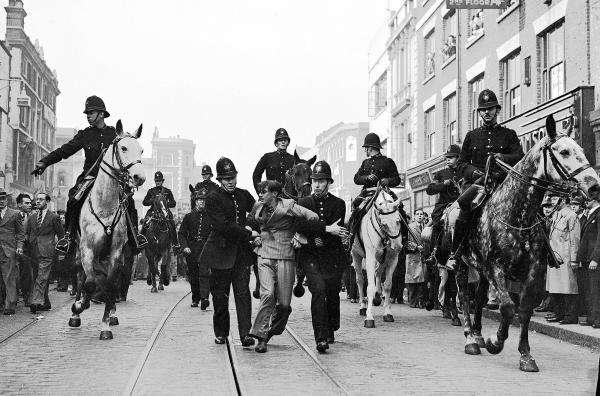
An anti-fascist demonstrator is taken away under arrest after a mounted baton charge during the Battle of Cable Street, London, 4 October 1936, Eddie Worth © Associated Press/Alamy Stock Photo
This photographic exhibition is therefore incredibly timely. It was conceived and curated by Steve McQueen, the acclaimed artist and filmmaker. It aims not only to explore how many different acts of resistance have shaped life in the UK but also how the crucial role that photography has played in documenting and actually driving change over the last century. McQueen has sourced his material from various archives, libraries and image libraries. He has deliberately concentrated on moments captured before digital cameras became ubiquitous.
There are some well-known photographers represented such as John Deakin, Fay Goodwin, Edith Tudor-Hart, Vanley Burke, Paul Trevor, Humphrey Spender and Tish Murtha, among others. And in keeping with the nature and content of the exhibition itself, a solidarity price for attending will be put at £2 minimum (or what you can afford) on the first Monday of each month until the exhibition ends on 4 January, 2026.
There are over 200 photographs covering a century of activism, resistance and struggle. The photographs cover the radical suffrage movement in 1903 to the enormous anti-Iraq war protest in 2003. They also feature the Blind March of 1920, a landmark struggle for disability rights. There are also photographs that deal with environmental campaigns, the famous Hunger Marches of the 1930s, the fight against fascism too in the 30s and 40s, demonstrations against racism and demonstrations for gay rights and women’s liberation. And there are captured memories of the Aldermaston and Greenham Common campaigns against the siting of US nuclear weapons.
There are photos of workers in struggle and a common aspect in some of these photographs is the role played by the state in all these campaigns with the police arresting people on many of the demonstrations featured. Again, the timeous nature of this exhibition cannot be stressed enough as the British state seeks to criminalise protest itself today.
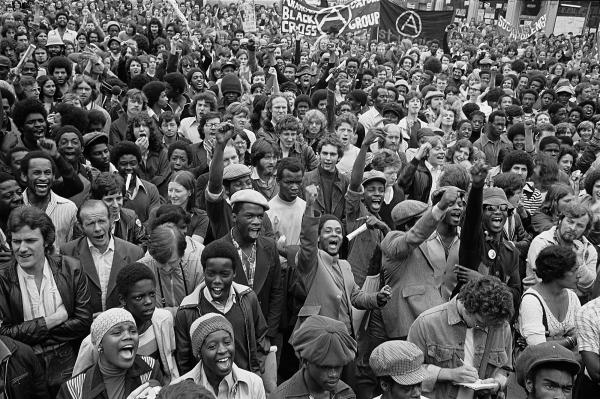
Anti-racists gather to block route of National Front demonstration, New Cross Road, London, August 1977 Paul Trevor © Paul Trevor 2024
Steve McQueen has said of the exhibition – ‘Resistance explores how people have challenged the status quo – a mission that feels especially urgent in today’s political climate.’ To open the exhibition itself there was an introductory lecture given by Gary Younge, the author, broadcaster and Professor of Sociology at Manchester University.
His gave a powerfully uplifting and positive talk concerning our ‘perilous moment.’ It was interesting for the Scottish audience to know that Gary had once attended Heriot-Watt University in Edinburgh. At that time there were those in Scotland who saw racism as an English disease but Gary countered this well by telling of a demonstration he attended in Edinburgh for the racist murder of young Ahmed Sheikh. He also recalled running up Lothian Road away from racist thugs who were chasing him with baseball bats.
Younge spoke of Netanyahu and his crimes against humanity and invoked the name of Frederick Douglas who once said that if there is no struggle, then there is no progress. Power concedes nothing without a demand, he said. Younge is probably not aware that a wonderful mural to Douglas exists on Edinburgh’s Viewforth where the great man once stayed.
He also mentioned Claudia Jones who first mooted the idea of a festival to counter racism against black people and to celebrate who they are. Jones, he said, could never have imagined that the Notting Hill Carnival would become the largest of its kind in the whole of Europe. Claudia Jones believed in the power of culture to create resistance in society and all the photographs in this exhibition imply a better world is always possible.
Younge spoke of the dreams we want to come true for our world and how these dreams have to be fought for to come to fruition. Where people are oppressed, he told his audience, ‘they will ultimately fight back.’ He mentioned CLR James who once said ‘you never know when it’s going to explode.’ History, of course, confirms this.
There was reference made to the British state’s ‘archaic and feudal practises at the heart of the body politic’ and suggested this was maybe why reform here has seemed preferable to revolution. Younge also mentioned three events that took place in 1981 at roughly the same time. The Republican prisoner Bobby Sands was elected MP for Fermanagh and South Tyrone after a deeply contested election in Northern Ireland, while there were riots going on in black communities across England as the march for jobs set off from Liverpool.
At the end of the century, Younge said, there were more people working in Indian restaurants in the UK than worked in the combined areas of coal, steel and shipbuilding. Clearly, only struggle and resistance can change this. In an inspiring lecture, he told us that so long as there is ‘inequality, injustice and plunder in the world, there will always be oil on the ground waiting for a spark.’
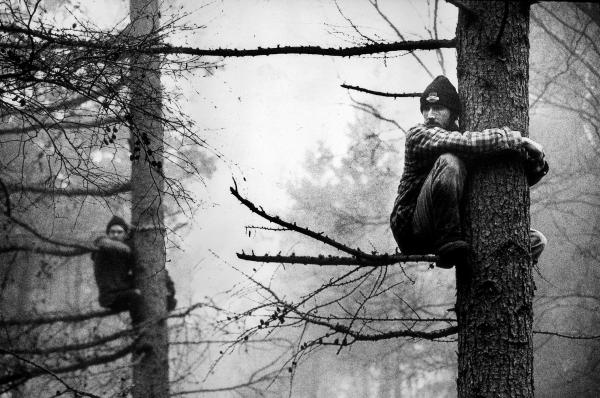
Protesters against the construction of the Newbury bypass occupy trees to prevent their destruction, Berkshire, 1996. Andrew Testa © Andrew Testa
From a Scottish perspective, there were few photographs with a Scottish connection. There was one against the Iraq war and one on the Free Pollok campaign against the M77 motorway extension of the late 1990s. McQueen must have put his call out for photographs in London but the paucity of Scottish input in no way detracts from the superb collection on view, Indeed, the exhibition should imply a similar callout within Scotland for a similar kind of exhibition.
The lecture by Younge was a perfect fit for an exhibition that celebrates resistance, celebrates the coming together of people for just causes, for solidarity of all people regardless of their race, sexuality, gender, disability. The exhibition shows the importance of solidarity over all issues, shows the desire not to be divided and to be inspired enough to dream of a better world that has peace and justice at its heart.

We are supported only by our readers. We don't have corporate backers and we don't take advertising, so we rely entirely on your support.
Help to support independent Scottish journalism
If there is a vote at Westminster to proscribe Palestine Action this will become the defining moment for the SNP and the Scottish Government.
If they choose to refuse to implement this legislation in Scotland we will then know that they really do believe in Scottish independence and Scottish values. If they put their jobs, salaries, pensions and freedom before what must surely be the will of the Scottish people not to have this legislation imposed on them, then they lose their right to claim they lead the independence movement.
If the latter, there will be mass resignations from the Party and they will lose the Holyrood election.
If the former, we’ll have the cause that will unite Scotland and ensure that within the year independence from Westminster rule will be assured.
Nothing happened after Brexit. Scotland taken out of Europe with SNP watching on in silence. Just can’t envisage them planting a freedom flag on a political hill for Palestine Action . I hope I am wrong.
The SNP watched on silence? I humbly suggest getting your hearing checked.
“the paucity of Scottish input in no way detracts from the superb collection on view”
Well done to Sir Steve Rodney McQueen CBE on his exhibition.
Is it still possible to feel compassion for palestinians without being criminalised?
Not being a member of any organization
I still wonder how far the definition might go.
Our very emotions are being dictated to it seems .
I think a red line has been crossed.
Stone hearts rule.
It does seem quite an erasure not to have more Scottish content in a show at the National Galleries of Scotland. If the intent was to show photography before the ubiquity of mobile phone cameras, then Kenmure Street would have been too soon. But where is the Miners’ Strike in Scotland? Faslane? The Poll Tax Rebellion? SCRAM? to name just a handful of significant historical points of resistance.
I don’t think it’s an erasure, it’s just an exhibition curated by a guy who lives in London which is on tour (presumably). Why would he have to think about Scotland?
Steve McQueen after all made HUNGER, based on the life of Bobby Sands, which no institution in Scotland would have touched with a barge-pole, let’s be honest. CS? No chance!
He’s a decent director with an impressive record for tackling big, polemical themes, if we’re lucky, maybe he can shoot something anti-Union and anti-establishment to do with Scotland, he has a much better chance of getting such a film made in Scotland than almost any Scottish director…
“Ewan”, and “Tilda” and “Lynne” and “David” are all too busy making films in America to bother their arses sweating blood over years to get something made here that mightly actually resonate…
Yeah I have no beef with Steve McQueen and I haven’t seen the exhibition yet so perhaps I should stay schum. But it just feels (again) like another cultural institution in Scotland but not of or for Scotland.
Looking it up, the exhibition was not curated with Scotland in mind specifically, as it was first shown in Margate in February.
https://turnercontemporary.org/news/turner-presents-resistance-an-exhibition-curated-by-steve-mcqueen
Maybe it could have been updated for the showing in Edinburgh but I suspect this is not normally the way – he curated it, then it tours. Maybe there could have been more Scottish content for this exploration of how acts of resistance have shaped life, so the exhibition is about resistance and is not ‘for’ any specific nation, but those who resist / are interested in resistance.
Do the National Galleries of Scotland always have to have Scottish content to be legit, to be ‘of Scotland’? What does ‘of Scotland’ mean?
No I don’t think National Galleries of Scotland always have to have Scottish content, that would be daft and parochial. I just think this is a missed opportunity. If you take the example of the feminist exhibition that was exhibited last year (we reviewed it – I can’t find the link!) it was about the women’s movements but included considerable archive material relating to Scotland.
Here it is: https://bellacaledonia.org.uk/2025/01/03/women-in-revolt/
That is interesting and I notice that exhibition was curated in collaboration with the National Galleries of Scotland. There’s the difference I guess. Be interesting to see the McQueen one. It begs the question of whether plans for it touring were known about when he curated it, or even they were, whether he cared that much given what he saw as his focus and the photography available to him.
One thing it does suggest, is where is the Scottish curator doing one focussed on Scotland? It could have been combined with McQueens.
A course run by the University of Glasgow on slavery in the British Caribbean documented some acts of resistance by enslaved women, who undermined work by go-slow and truancy, and used abortifacients to prevent giving birth to children who would be enslaved. This was an environment in which even continuing your own traditions, language and names were everyday acts of resistance.
Some of the most effective forms of resistance may come from within ruling structures, such as whistleblowers and refuseniks, armed forces mutineers and even elite traitors.
In militaristic societies, silent and persistent sabotage of the military machine (as portrayed in Schindler’s List) may also be effective. Or by propaganda of the word, countering official propaganda and lies, offering analysis and comparisons, asking difficult questions.
In other cases, glass ceilings have been broken by pioneers, even if recognition came late for them (sometime long after death). Long careers, diligence and achievement eventually dispelling all rational objections.
None of the above seems particularly suited to being captured on camera.
(and sometimes the camera is a false guide; after all, the SpyCops were pictured at such demos too)
I am not criticising such a show, nor the tradition of street protest, but in our surveillance society (as in the past), the most important kinds of resistance may go largely unseen, often carried out by anonymous people in their daily lives. And while we may not be able to recognise them individually, we should recognise them collectively.