
Yesterday’s Men
‘SNP on track to win 67 seats in Holyrood landslide’ screams the headline.
In polling just out, YouGov projects that the SNP is currently “highly likely to win a majority, based on its first ever Holyrood MRP poll”. The Times reports: “Of thousands of simulations, nationalists won outright majority in 89% of cases.”
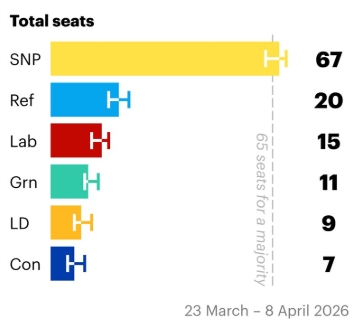
This is the YouGov / Sky / Times Scottish Parliament MRP poll:
Seat projections based on current state of play:
SNP 67 (+3 vs 2021)
Reform 20 (+20)
Labour 15 (-7)
Green 11 (+3)
LibDem 9 (+5)
Con 7 (-24)
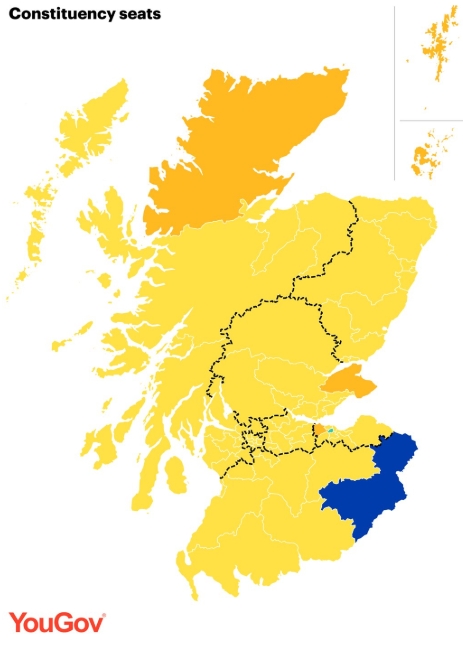
Some standout facts from this poll:
Jackie Baillie to lose constituency she has held since 1999
Labour to be wiped out in constituencies
Tories to become smallest party
Russell Findlay to lose his seat
SNP would win its fifth consecutive election, the first with overall majority since 2011
This would be the highest number of pro-independence MSPs ever
Imagine having almost the entire Scottish media at your back, and failing this badly?
The response from the Unionist press, politicians and influencers is a mixture of rage-quit, incredulity, and denial. Here’s some favourites. Merryn Somerset Webb, she of the infamous ‘‘Nicola Sturgeon Stole My Skiing Holiday’ is inconsolable, screaming: “Vote for the nightmare that is the SNP in order to avoid the actual and complete hell of an SNP/Green coalition” at Daily Mail headlines.
The Tory MP Andrew Bowie tweets, in response to Sam Coates reporting the poll results for Sky News: “The threat of an SNP Majority is *very* real. Scotland cannot afford another 5 years. There’s a way to stop this…Peach Ballot Scottish Conservative. Anything else is a gift to Swinney.”
Kind of sweet, isn’t it?
Poor ex-Tory Councillor Thomas Kerr is looking is seeing the bright side of things: “There’s just under four weeks left and it’s on all of us to stop John Swinney’s rotten SNP. Labour and the Tories are finished. It’s now Reform vs SNP – Hope vs Division – Optimism vs Decline. Let’s do this folks!”
Meanwhile, Anas Sarwar has got on a big red bus.

It’s clear that the response from the Unionist media over the next three weeks will be to monster the Greens, scaremonger about an imminent referendum (while simultaneously denying one), try to evoke Project Fear again and just rage against the stupidity of the electorate.
But what will they do after?
It’s a very slow learning curve to repeatedly block any prospect of a referendum and defend a Union that you cannot leave. The Unionist parties are now reaping the rewards for such intransigence.
I predict three broad responses after May 7.
The first will be to try and re-frame this as failure. Pointing to the relative decline of the % of the SNP vote, the scribes and editors will re-cast this as a disappointing result, and not really a victory at all. There will be efforts to blame the D’Hondt electoral system, or some such nonsense. None of this is remotely credible, but it has already kicked-in.
The second will be to ridicule the electorate itself. This is the Brechtian response, that the state should “dissolve the people / And elect another.” Supporters of the pro-indy parties will be labelled extremists, too young, too naive, not sufficiently grateful for oil/climate change/the Union, or whatever. This has already started.
The third may be to take something from this. Sarwar and Findlay will be replaced. If the remaining Red and Blue Tories take nothing from these results, they will be consigned to history: Yesterday’s Men. That’s fine, I don’t really care, but at some point, you’d imagine it might dawn on them that isn’t a winning strategy? Even if there’s no moral compass pointing to the fact that an Involuntary Union is an anti-democratic phenomenon, you’d have thought that just on pure survival instinct, the Unionist chiefs would think again?
It wasn’t supposed to be like this.
As Jamie Maxwell says on this podcast HERE: “18 months go Labour expected to win this election. 18 months ago the SNP expected to lose this election. 18 months ago the idea of Reform UK having a presence at Holyrood was laughed at.”
The presence of Reform UK at Holyrood is the dire consequences of British political failures and toxic policies, but it also points to a narrowing of the Unionist position and a shift firmly to the right. While Unionists used to talk about a ‘Family of Nations’ and a ‘Partnership of Equals’ (both complete fabrications), you don’t here anyone defending the Union at all anymore. As Murray Pittock has put it: “You think Scottish Unionism is all around you but actually the case for Scotland as a distinctive country within the Union has more or less disappeared from political discourse. Now it’s a straight fight between Scottish and incorporationist tribalism.”
If, as seems increasingly likely, the ‘centre’ collapses and the choice is between self-determination and rule by a neo-fascist Reform UK government at Westminster, it’s very clear what direction that’s going.

We are supported only by our readers. We don't have corporate backers and we don't take advertising, so we rely entirely on your support.
Help to support independent Scottish journalism
History suggests that once the pervasive contempt that English Unionists have for Scottish Unionists becomes impossible to ignore, the end of the Union will be nigh. For by the elitist ideologies of both, Unionism should attract and bring out the best. When the reverse is evident, the cognitive dissonance should become unbearable.
SleepingDog, it seems to me that a central part of irish unonism has always been a partly conscious preference for being patronised by English unionists, rather than being ruled by people who they see as native savages.
Scottish unionism also has a lot if thst mentality.
Time to seize the moment! Give positive energy and support to the SNP. Let the wider electorate come to see it , and Independence as sexy!
Secure an overwhelming Pro Indy government on 7th May.
Come together to describe Independence version 1.0 , build an overwhelming majority and demand a Referendum before next GE.
Dont really want to be negotiating with a Reform government and their MAGA backers
All it needs is a positive , constructive energy around Scotland forging a new beginning as the Worlds first full on wellbeing economy. There will be many countries around the world wiling to invest in that and secure it becomes a reality which they can then further expand and develop.
Keep knocking on doors and talking to people. Nothing’s in the bag till it is.
Mike Small is of course right that the failure of unionism in zscotksnd is in no way due to the electoral system. The unionist plight is the product of intellectual bankruptcy.
But still, the d’Hondt system is looking very shoogly. It seems set to give more than 60% of the seats to the Greens and SNP, on a combined total of 45% of the votes in both the regional and constituency ballots. That’s a significantly non-proportional result, tho obviously nowhere as bad as the grotesque 2024 UK general election result where Labour got an obscene 62% of seats on 33% of the votes.
The fact that the d’Hondt system currently favours pro-indy parties suits my pro-indy goals fine in this election. But if unionism got its act together instead of being split four ways in constituencies, the disproportionality could be radically flipped.
If a single unionist candidate could win 70% of the unionist vote which is current split 4 ways, the unionists would win most of the constituencies, and the indy mobement marginalised in Holyrood.
It’s time to start building a progressive consensus for electoral reform in Scotland, by switching to STV for a Holyrood elections as well as the councils.
Well this is very true. My only point is isn’t it fun that the Unionist parties have got all exercised about this in the middle of a campaign they are losing? By all means have a debate about the system, just not during an election?
Yes, that is indeed great fun!
It seems to be an article of faith among unionists to never complain about election systems which hand them dumper trucks of unearned seats, so there is great comedy watching them whining here. It’s especially fun to see them whining about the electoral system which they designed so as to prevent an indy majority, but which has now been hacked by indy supporters who understand some simple maths. HAHA
Claire – much as I personally despise Reform it is the votes they are taking from Labour & Tories that current polling indicates is the major factor in SNP gaining as big a victory in seats as in 2021 despite their vote share dropping significantly.
The other issue that needs to be addressed is MSP’s taking their seat on list election after election despite never winning a constituency vote (the Murdo Fraser effect). Perhaps it would be better if MSP’s were only allowed to be elected via list on two successive elections?
John, yes of course it’s the ReformUK-driven split in the unionist vote that will deliver an indy majority this year. My point is that in a democracy, votes should be roughly proportional to seats. The indy majority is welcome, but it is a transient quirk of a broken system which impedes democracy. It should be replaced.
As to your proposal on term limits, it seems to be based on some strange notion that the absurdly anti-democratic FPTP system used in Holyrood’s single-seat constituencies has some greater legitimacy than the proportional system used for the regional lists. That’s an abhorrent idea.
Term limits would have removed several of the most significant MSPs before they reached their prime, while constituency seats remain safe for muppets.
I deplore both halves of the Holyrood electoral system. The FPTP constituencies are an absurdity, where a high proportion of seats will be handed to candidates with under 40% of the votes, amd a significant number to candidates with less than 30% of the votes. That’s beyond a scandal; it’s an obscenity. And it’s made worse by the fact that since 2011, a half-witted duck is a guaranteed winner of the seat so long as it has an SNP label. Sady, there is a non-zero number of half-witted MSPs elected for the SNP. Edinburgh Eastern is a prime example.
The regions allocate seats by party, in proportion to votes. That’s better than FPTP. The downsides of this Scottish implementation of d’Hondt include the fact that the parties get to choose the lists and their order. There are modifications to d’Hondt which could improve this, such as open lists, but if you want to remove party control, then STV is the way to do that. STV gives voters flexibility to escape party control.
Claire- probably better to look at what would be best and fairest voting system (including how to ensure all regions are properly represented) for an independent Scotland than trying to change the current devolved system. The d’Hondt system has worked pretty well so far and this years election may only be a one off aberration due to sudden rise of Reform.
It is highly unlikely that Westminster based parties opposed to independence could work together and be successful – there was an element of tactical voting amongst those opposed to independence in 2021 and that didn’t have an enormous impact on overall result. It is difficult to see a unionist supporting bloc agreeing to back one candidate especially if Reform and Tories were involved. In any case a Holyrood election that was a straight choice between an independence supporting party and a UK supporting party would highlight the independence cause and potentially make election a de facto referendum.
Two terms of being a list candidate is a ten year duration. How many people expect to stay in same job for more than 10 years nowadays? Being an MSP is about being a representative of the electorate should not be looked upon as a secure career option. It should therefore carry a degree of electoral accountability. If the electorate reject an individual three times in a row in a constituency vote thst individual has little electoral credibility left to continue to sit as an MSP. This doesn’t preclude the individual trying to stand as a constituency MSP in future.
John, you seem to be still fixated on the bizarre notion that a multi-term list MSP is xomehow less legitimate than a multi-term constituency MSP who will nearly always have been elected with a minority of the vote.
It’s a very odd position. You seem to have taken on board the Wings zoomer’s idea that the FPTP constituencies are superior and that proportional representation is somehow second class.. if anything, the illegitimatvy is the other way round, because nearly all constituency MSPs are rejected by a majority of votes. Please stop reading zoomers like Stu.
As to the broader question of the electoral system, it is unarguably broken. It was designed to produce a proportional result, but voters have learnt that it can be easily hacked to produce a very non-proportional result.
Claire – I have no truck with people like Stu Campbell and his ilk and am an SNP member. I have not read anything from Wings or Campbell since about 2021 and find many of his views objectionable.
I am trying to make a point about the democratic process in Holyrood in response to your comment. I do not regard list MSP’s as second class I merely question whether someone should be allowed to repeatedly sit in Holyrood without some direct personal mandate. I sure we can all agree that the connection between voters and elected MSP’s is vital for a healthy democracy. Your claim that someone who loses the constituency vote but is elected via the list carries more democratic validity than an individual elected via the constituency vote is in my opinion a rather odd view of the democratic process. I am sure I am not an outlier in questioning your viewpoint on this.
I also have no wish to continue, what up until your last comment was a perfectly reasonable, polite discussion, with someone who cannot disagree with me without resorting to personal abuse.
John you clearly do hold to the Wngs view that list MSPs lack legitimacy.
And you also seem unable or unwilling to comprehend that nearly all of the constituenciy MSPs have been rejected by more than 50% of the people who voted. It’s not a complicated point. You can see it for yourself if you go visit the Wikipedia articles on the Holyrood constituencies.
Claire – under D Hondt system nearly every list MSP will have failed to be elected as a constituency MSP ie they will have personally received even less votes than the elected MSP so your validity argument is a bit spurious.
I do not regard list MSP’s as second class MSP’s. I am merely questioning whether someone who has personally been repeatedly rejected by the electorate under current system as Murdo Fraser has should continue to serve as an MSP and more importantly have a say on the future legislation impacting the electorate.
Your reference to the electorate electing muppets as constituency MSP’s betrays a contempt for the electorate as much as the MSP.
John, you still seem unable or unwilling to grasp some very basic maths. Please can you set aside your presumptions and READ.
In most Holyrood constituencies, every candidate receives less than 50% of the votes cast. Therefore all candidates have been rejected by the voters.
In mature voting systems, a further step or steps is taken until one of the candidates has won 50%+1.
Under STV, second and further preferences are counted until one candidate get more than half the votes. In French elections, a runoff system is used: a second round of voting is held between the two leading candidates. That way, one of them has to top 50%.
However, in the FPTP system used in Westminster elections and Holyrood constitutes, there is no second round, instead FPTP just gives the seat to the most popular of the losers. Some of those most popular losers have got less than 30% of the votes. You are used to regarding those losers as winners, but they are not winners. They are just the beneficiaries of a rbroken system.
You are used to the FPTP system, so you think its normal to label losers as winners. But it’s not normal: few European countries use it, and none of the UK political parties uses it for internal elections.
If you take a closer look at those constituency elections, you will see that the consequence MSPs are mostly rejects. It is normal for 100% of a constituency’s sears to be allocated to a party with ~40% of the votes. Why on earth do you regard that huge injustice as fair? Why on earth do you think this is somehow better than having seats allocated proportionally by d’Hondt?
Claire – the use of capital letters is a bit Trumpian! I may not be Prof John (Curtice) but I assure you that the mathematics and statistics qualifications I have got have left me more than able to review election results.
I have previously written that a different PR system would be more suitable for an independent Scotland. D’ Hondt is however not as bad as Westminster FPTP and has served Holyrood reasonably well from a representative point of view up to this year. I now personally see devolved parliament as a staging post to an independent national government so I don’t consider changing its electoral system as a top priority.( I think changing Westminster’s FPTP is a much more urgent priority). Would any change to the devolved parliament system not require Westminster consent anyway? Every other constitutional issue seems to.
I think we will just have to agree to disagree about MSP’s being elected repeatedly via List system.
All the best.
John you appear not to have my latest reply other than to complain about my capitalisation of the 4-letter word READ.
You entirely ignore ,my point about the systematic illegitimacy of the constituency results, and prefer a vague assertion that the system has “served well” instead of actually examing it’s features.
Pity.
Claire – One last observation on your assertion that list MSP’s have more electoral validity than constituency MSP’s is that most list MSP’s have themselves failed to be elected in a constituency ie they have initially been rejected by a larger sector electorate than the successful constituency MSP’s. I will however agree that the D’Hondt system is not ideal and the upcoming election will highlight its imperfections.
I do however think we need to put the debate about the shortcomings of the D’Hondt system in some perspective.
It seems apparent to me that the Westminster FPTP system is more unfair in outcomes than the Holyrood D’Hondt system. In 2024 Labour got 2/3rds of seats with 1/3rd of votes cast and in next GE a party may get an overall majority with around 30% of votes- current polling makes this an even more worrying prospect. In upcoming Holyrood election the SNP may just about scrape an overall majority (highly debatable) with between 35 -40% of votes cast. In addition Holyrood is subservient to Westminster rule and Westminster has far more power than Holyrood. For all the shortcomings of the D’Hondt system if we are talking about the need for changing an unfair electoral systems it is changing the Westminster system which needs to be prioritised.
The two main traditional parties Tory & Labour appear most resistant to electoral change at Westminster because it has benefited them both at different times in the past. If either of them start complaining about the fairness of Holyrood system after a poor result in upcoming election while ignoring the more urgent need to change the Westminster system it would in many people’s eyes be rank hypocrisy.
John, this duscussion os about the current Holyrood ekection. You are unable or unwilling to understand the numerical basis of the Holyrood constituency system, and you seem determined to try to deflect into whatboutery.
I’m not playing. We could discuss Westminster another day, but this discussion is about H9lyrood.
You are still fixated on the Wings idea that instituejcy MSPs are more legitimate than list MSPs.
That is mathematically and politically false. In all constituencies, 100% of the seats go to just one candidate. In most constituencies, 100% of the seats to less than 50% of the voters.
But in the d’Hondt regional lists, the seats are allocated fairly in peroportion to the votes cast.
You have repeatedly gotten the sitation back to front. You are much more interested in defending your false assumptions than in scrutunising facts. Enough. Discussion with this much denial and deflection is neither a productive nor an enjoyable use of my time. Bye!
Claire – you yourself cited how the Westminster electoral system was less proportionate than Holyrood one in an earlier comment. It is the elephant in the room when undertaking any discussion on electoral systems in UK. If Reform win next GE on 30% of UK vote (probably considerably less in Scotland) we could well not have a Holyrood Parliament to debate about at all.
I have conceded that the d’Hondt system is not ideal and that the upcoming election will highlight this. I personally don’t see the point of trying to amend Holyrood electoral system without first changing the Westminster one. I also think it is better to prioritise an independent Scotland than get bogged down in arguments about electoral process of the devolved Parliament. This doesn’t preclude us from learning from weaknesses of current system when setting up electoral system for an independent parliament.
With regard to the d’Hondt system I have not stated that I personally consider List MSP’s as less important than constituency MSP’s. Your premise appears to be that constituency MSP’s have less of a mandate as they rarely achieve 50% of vote. This is true but I have also pointed out that under current system virtually all list MSP have stood as constituency MSP’s and failed to be elected. This is not to undermine their legitimacy as a list MSP but is a fact that they have been initially rejected by electorate that you seem unwilling to even acknowledge. I have also merely queried whether, under the current electoral system, an MSP who is repeatedly personally rejected by electorate at constituency level doesn’t lose a degree of credibility with electorate by returning as a list MSP indefinitely? I accept you don’t agree with me, but to characterise this view, which I am sure is widely held, as extreme and undemocratic is not reasonable.. One of the most important elements of any electoral system is surely the level of validity and credibility the elected representatives enjoy amongst the electorate?
I have tried to debate you in a civilised manner but to be honest I don’t think this has been fully reciprocated.
Joh, you started this sub-thread by making Winfgs-derived assertions about a problem you perceive with H9lyrood list MSPs.
I think you are wrong, and have explained in some detail why. But instead of sngaging with discussion on the point you raised, you are ubable or unwilling to re-examone yiur own flawed assumptions.
You have two modes of response:
1/ to make bread, unevidenced assertions which amount to nothing more than your likes or dislikes.
2/ to reoeatedly try to deflect the discussion into whataboutery. Yes, Westminster elections are crap. But that’s not what we are discussing here.
I don’t know whether you are deliberately trying to disrupt discussion, or whether you are intellectually unable to stay on topic. But it doesn’t really matter, becauseeither way I see no point in trying to discuss with someone won’t stay on topic, and who evades analysis their own stance.
If this site allowed me to block other contributors, I would now black you. Bye!
Claire – I have informed you before that the issue I raised about list MSP’s failing to be elected via constituency is one I have personally thought about and discussed with many other people who have raised a similar concern. I can assure you that this concern didn’t originate from me following Wings or any other blogger but seemed self evident to me..
I am happy to accept we have a different viewpoint on this issue but I take great exception to you denigrating me by smearing me as being some sort of Wings follower- nothing could be further from the truth.
I have laid out my thoughts quite plainly on why I think that under the current d’Hondt system I have reservations about people who are repeatedly rejected by electorate under constituency votes returning as list MSP’s without any limitation. However much you may personally disagree with this point of view it is neither extreme or undemocratic as you appear to try and paint it. We obviously disagree over this issue and you have explained why you disagree and I respect that. I don’t however respect the arrogant, impolite and dismissive tone that you adopt to someone who genuinely disagrees with your point of view.
John, you can complain all you like.
But no amount of complaint from you alters the logical fallacy of your repeated advocacy of the the Wings claim the list MPs are less legitimate than constituency MSPs. No amount of complaint from you alters the fact that you unable or unwilling to try to comprehend the simple maths that disproves the claim.
And no, I do not respect people who stubbornly refuse to engage in critical thinking, but still demand dialogue.
I’m sorry Claire but you do come over as a bit arrogant. I fully understand your mathematical reasoning but I don’t agree with your application of it to the current electoral system in Scotland. This means we have a different point of view- neither of us can claim to be definitively right and to assert this and then dismiss my point of view by accusing me of lacking critical thinking is another indication of your arrogance.
Your constant repetition accusing me of being some sort of wings zealot is not debating the issue it is an attempt to smear me and my opinion by association. It is not uncommon to agree with someone on an individual point while not agreeing with them on many other issues. I make up my mind on issues based on my own personal values and evidence not based on how it aligns with someone else’s point of view.
Ps – my understanding of this site was that the editor would block someone if they were abusive, racist or misogynistic or if they were obviously trolling not for disagreeing with someone on a relatively obscure point of electoral representation as you appear to have threatened.
Time to call it a day methinks.
John, you have a different point of view because you irrationally and perversely prefer the disproportional results of FPTP to the proportional results of d’Hondt on the lists.
You have repeatedly insisted on the primacy of the constituencies, even though they use a voting system which is designed to be unfair.
Take for example the 9 Glasgow constituencies. The SNP won 100% of the seats on about 50% of the total votes. That’s a blatantly unfair allocation of seats.
You choose to regard the unfairness as superior. You are offended that the list MSPs have been elected fairly in a system whoch alloctes seats in proportion to votes. You object to the list MSPs because they have won a fair system, not a rigged system.
If you want to continue to champion a system which is designed to be unfair, then please have the decency to explain why you champion a system which is designed to return skewed results. But your choice to defend deliberate disproportionality without explanation 8s arrogant and irrational, and unworthy of respect.
Claire – sorry but I must reply as from what you have written I don’t think I have made myself clear:-what I am trying to say is:
I don’t think, or have said, the d’Hondt system is ideal. Overall it has given a reasonably proportionate outcome to votes cast in elections to date but realise the upcoming election may not. The issue of d’Hondt system has barely registered with the electorate to date though again this may change after election.
The Westminster system is far more disproportionate than Holyrood system. I am not opposed to changing both systems to STV system but think that while we remain in union the focus should primarily be on changing Westminster system as it is even less proportionate than Holyrood one. I am not opposed to changing both at same time. I am also very sceptical of any Labour, Tory or Reform politicians criticising fairness of Holyrood election system while they continue to support FPTP system at Westminster for their own party benefit.
Lastly while we have the current d’Hondt system I have highlightedthe instances of when an MSP continually loses in constituency vote (ie has been personally rejected by electorate on multiple occasions) but continues to be re-elected as an MSP on a party list. I am not arguing that they have less democratic legitimacy but questioning whether they have the same level of personal credibility with the electorate. This is a personal opinion which I am sure is shared by many members of electorate.
I understand you don’t agree with me for reasons you have outlined. I don’t object to anyone disagreeing with this or any other of my opinions but I do value a polite, respectful discussion.
All the best
I hope this has clarified everything.
All the best
John
John, I’m sorry to have to say that I regard your contributions as neither polite not respectful. Your reoeated resorts to whataboutery (“Westminsterbis worse!”. True but irrelevant) are an exercise in distraction, obfuscation, and time wasting.
The FPTP system in the constituencies is grotesquely unfair. In 2021, it gave one party 62 of the 73 constituency seats: https://en.wikipedia.org/wiki/2021_Scottish_Parliament_election#Glasgow. That’s 85% of the seats on 48% of the votes.
That result is not just unfair. It is perverse. Itbis grotesque. It is obscene. It is a mockery of democracy.
But you don’t just support this obscenity. You actually advocate weaponising this obscenity against MSPs elected by the fair d”Hondt system system, which allocates seats in proportion to votes. Like the hatesite Wings which promoted the idea you advocate, you want to punish the fairly elected MSPs for not winning in the unfair system. You are arming the bad against the good. You are actively trying to make a bad situation even worse.
Instead of addressing the anti-democratic nature of your proposal, you have repeatedly stuck by it, but without giving any reason for why you choose to treat unfair elections as preferable.
You have had plenty of opportunities in this duscussion to offer a primcipled defence of unfairness. But each time you have evaded with verbose deflection. So I conclude that you are not actually trying to make a good faith analysis of the situation.
From the limited info you privide, the best explanation for your stance is that you seek partisan advantage for the party you currently support, by defending its wins for your party while denigrating and disqualifying MSPs elected fairly. In other words, you are an anti-democrat who seeks to rig elections in your favour. This is the same anti-democratic mindset as the American Republicans, who systematucally steal elections by gerrymandering districts and suppressing voters.
I don’t see anything either polite or respectful in your repeated use of false claims and deflections as you promote an attack on democracy. I’d have some respect for a person who honestly stated their goal of rigging elections for partisan advantage. But for this weaselly deception, I have no respect at all.
Claire – I regret for even getting into a debate with / lecture from you.
I should’ve followed my dad’s advice – never get into a discussion with a zealot!
No, John, you did not enter into a debate. You are the zealot, and you persistently refused to debate.
I tried to debate with you, but you repeatedly engaged in evasion and deflection. Instead of reasoning, you just offered assertions of your personal preference.
And all because you want to rig the electoral system, like a gerrymander, by punishing the fairly-elected MSPs for not having been elected under a blatantly unfair system,
You are an anti-democratic zealot, John. A partisan who is trying to rig the electoral system to his own partisan advantage, by promoting an idea championed by a hate site. And you don’t even have the honesty to acknowledge your anti-democratic goal.
I analysed the effect on the 2021 Holyrood election of Gerrymander John’s proposal to ban regional list MSPs from serving more than two complete terms on the list.
John wants no term limit on MSPs elected by the grotesquely disproportionate FPTP elections in the constituencies. Instead, Gerrymander John wants to rig the system AGAINST those elected on the fair, proportional lists.
The effect would have been to ban at least 8 long-serving MSPs. If the criteria were loosened, 10 MSPs would have been banned. Full list below.
As I suspected, none of those ten MSPs were SNP. The ban would have fallen entirely on the opposition parties, who would have seen 15% of their MSPs disqualified.
So the effect of John’s proposed gerrymander is blatantly partisan. It’s a scam to cull experience from the opposition.
But as you can see above, Gerrymander John is very offended that his scam is exposed.
Mark Griffin, Labour, Central Scotland
Patrick Harvie, Green, Glasgow
Rhoda Grant, Labour, Highlands and Islands
Alison Johnstone, Green, Lothian
Mark Ruskell, Green, Mid Scotland and Fife (non-consecutive)
Claire Baker, Labour, Mid Scotland and Fife
Liz Smith, Labour, Mid Scotland and Fife
Murdo Fraser, Conservative, Mid Scotland and Fife
Maurice Golden, Conservative, North East Scotland (switched region)
Neil Bibby, Labour, West of Scotland
I totally agree.
I agree with your agreement.
Wanders off confused….
In the New Statesman, the increasingly self important pontificator, Andrew Marr has a disdainful piece about the likelihood of another independence referendum and how ‘we’ will all be talking about ‘ethnic nationalism, hard borders, currency and UN membership’ for the rest of the year.
How frightfully awful for the poor man!
All these four aspects were all Project Fear derived. It was they who claimed Scots were being exceptionalist – but Scots voted to remain European, while the unionists in England and Wales voted for Brexit. It was the unionists who spoke of hard borders. Scots wanted a similar free movement concept like that Ireland has had since the Free State was established. It is Brexit unionists who want to keep out foreigners. Much more work has been done on the currency now and Sterling is not the robust currency the unionists spoke of. When Scotland votes YES, the pound will slump because of the loss of oil and gas and renewables.The UN will, of course, accept an independent Scotland after a fair referendum.
Marr’s bombast is symptomatic of the lack of any serious thinking amongst unionists.
Agree re Marr and lack of any serious discussion from unionists..their parties…and Scottish independence. Wes Streeting today, Sunday, was atypical in his bombastic..we’re not allowing…stance. But for any (serious? respected? ) unionist to come forward to discuss..not debate..Scottish independence …would be a step too far. Almost as .‘if we talk about it, it could happen” . It would take away their unionist Presumption of ‘not allowing’. However….post elections …I can see the derogatory outpourings happening all over again of why it’s not really a vote for independence,,,.and even the warped..’unionists voted SNP to keep Reform out’..some form of not splitting the unionist vote!
,I wonder if one such serious, respected unionist would ever step up to take part in such a discussion ..or would that be too much like admitting the inevitability of the break up.
Any day now Workers Party Scotland will make an impact in the polls and then we’ll see how the smaller parties will benefit from the D’Hondt system. Just bin the Tory vote and give your peach vote to Workers Party Scotland – we are against war, we want independence and will work with the global community through our leader George Galloway who has better international connections than anyone else in Holyrood.
This is going to be a memorable vote.
So the Workers Party flipped from opposing independence for years, and suddenly you’re all pro-independence.
Yery persuasive.
What’s the WP’s current stance on George’s view that a man doesn’t need to seek consent before each insertion?
We can’t afford to allow Reform in any shape or form. If we have this strong majority we must use it to cut the chains from Westminster. Only then will Scotland flourish.
Fine words.
But how?
“It’s a very slow learning curve to repeatedly block any prospect of a referendum and defend a Union that you cannot leave.”
But effective nonetheless since 2015.
There is no reason to believe, regardless of the outcome of the 2026 Scottish election, that Westminster will continue to dismiss/ignore, with consummate ease, the pathetic and pusillanimous approaches from John Swinney and his SNP.
Thanks so much, Duncanio, for taking the time to express your contempt for democracy and for the concept of a parliamentary majority.
Westminster took a similarly contemptuous attitude to the result of the 1918 general election in Ireland, when Sinn Fein won 73 out of 105 seats. Westminster thought it could just ignore Dail Eireann.
Now Dail Eireann is 107 years old. It is one of the oldest uninterrupted democratic parliaments in Europe. And there is no human alive in Ireland who remembers a British Lord Lieutenant ruling Ireland.
Spitting on election results and overriding parliamentary majorities is not the way to get yourself into the good guys list in the history books.
No thanks required for stating the obvious.
Only blind, deaf and dumb party loyalists believe that John Swinney and his SNP have been anything other than deleterious to Scotland’s Cause since 2014.
I expressed no contempt for democracy. I did, however, point out that Swinney – should he makes a begging request – will be dismissed or ignored by Westminster.
Indeed he has, for the umpteenth time, had his request pre-emptively rejected out of hand, in case you hadn’t noticed or comprehended Wes Streeting’s utterances at the weekend.
That is, he has been rebuffed by the very people who actually have contempt for democracy yet whom he continues to place above the authority of the Scottish people.
As for your Irish comparison, this is bogus. For more than one reason. However, the main one is that the in Ireland the Sinn Fein leaders displayed courage. In Scotland John Swinney bluffs & blusters while his underlings whine and whinge.
John Swinney is no latter day Michael Collins or even Eamonn de Valera.
And the British know it.
Duncanio, you chose to start your reply with an insulting, pre-emptive dismissal of the sensory capabilities anyone who might disagrees with you.
That is the language of a schoolyard bully. It discredits whatever point you were trying to male and whatever cause you support.
You are cleanly not here for a civil discussion. Bye!
From the one who spouts this
“Thanks so much, Duncanio, for taking the time to express your contempt for democracy and for the concept of a parliamentary majority.” comes this:
“Duncanio, you chose to start your reply with an insulting, pre-emptive dismissal of the sensory capabilities anyone who might disagrees with you. That is the language of a schoolyard bully.”
without any sense of irony.
You’d best stay out of the kitchen.
Duncanio, I commented on what you said about the topic.
You chose to reply with an ad hominem attack on the physical sensory capabilities of anyone who disagrees with you.
I repeat that you are conducting yourself like a schoolyard bully.
I thought you were finished?
I note that you never address any points raised and merely resort to a little bit of childish name-calling to cover up your argument vacuum.
Grow-up.
Duncano, I learnt long ago to never try to debate anything of substance with someone who engages in ad hominem anuse, as you did with your opening remark about “Only blind, deaf and dumb party loyalists”.
You chose to be behave as a bullying troll. If you don’t like being treated like a bullying troll, stop behaving like a bullying troll. Bye!
Whatever you have learned it’s certainly not to debate.
Quite the opposite, duncanio.
I enjoy debate, and do lots if it.
But your game of ad homindm abuse is not debate. It’s just bullyboy attempt to shut down debate.
Bye!
That’s 3 “Byes” – surely you’re out now.
But I suppose you have not got any credibility left to lose.
Mandated, recallable delegates are an alternative to elected representatives:
https://theanarchistlibrary.org/library/morpheus-a-brief-history-of-popular-assemblies-and-worker-councils
I was thinking about this when I heard an opinion of the ten elected Athenian generals that served at the (dis)pleasure of their Demos. Because the generals could be (and sometimes were) tried and executed for (allegedly) failing their mandates, this led to some sub-par military operations and unreliable reporting from the field. And generals like Nicias were appointed (for the Sicilian expedition) who had opposed their orders from the start. Recalling a general from the field (which happened in the case of Alcibiades) could throw a campaign into disarray.
I’m not saying that democratic Athenian generalship was closely comparable to delegates to popular assemblies and worker councils. But I am saying that for political systems, practice often deviates wildly from theory, and human psychology and motivation must be considered, just as for elected representatives (which are a more aristocratic, elitist notion). In any case, mandates require more work for the Demos, and there was evidence that even the very politically-involved partial citizenry of Athen were lazy sods (easily swayed by demagogues) when it came to making even the most consequential decisions of their day. Of course, ignorance, avarice and wishful thinking played a large part in the Sicilian Expedition disaster, not unlike perhaps the Darien Expedition disaster than many Scots voted for with their wallets.
Mandated delegates render parliaments unworkable, beca6se delegates can’t modify their stance to achieve a majority decision.
@Claire McNab, parliaments tend to work in various ways at different levels in different places, but yes, mandated delegates are given much less wiggle room (and if they exceed or fail their mandates, then the standard option is recall). But on the other hand, how does letting representatives Crossing the Floor (switching party allegiance) support democratic norms?
https://en.wikipedia.org/wiki/Crossing_the_floor
As the Commons Library explainer says, this is the aristocratic (Edmund) Burkeian distinction between a representative and a delegate. And automatic by-elections for switching parties were only very recently (2026-03-16) debated in Westminster, I gather, as a result of a rare petition accruing more than 100,000 signatures. MPs are generally very reluctant to be bound by rules. Anyone know what happened?
E-petition debate relating to automatic by-elections after Member defections – Monday 16 March 2026
https://www.youtube.com/live/f6d6zJOGBww
Roz Savage MP for the petitions committee:
“So the key question today is when voters (6 minutes, 45 seconds) decide who to vote for, what exactly is it that they’re choosing?
“(8:29) this petition invites us to consider what should happen if one of those factors, namely political party affiliation, changes during the course of a parliament.
“(15:10) And I’d like to share some perspectives from other countries because this is not a uniquely British debate…”
Recognition of a complex of factors including tactical voting [SD: I would suggest the ‘lesser evil’]
Robbie Moore MP:
“(19:52) standing on our manifesto pledges”. Voting slips have party affiliations and logos beside candidate names. Trust is at stake [SD: I think polls have suggested that politicians are often the least trusted group in British society].
Party leader not on ballot paper. Promises, platforms and commitments are important.
Q: If choice of PM is in voters’ minds, shouldn’t a change of PM trigger a general election?
[SD: after this, it is mostly party interests, some point-scoring, MP job-protection and irrelevant speechifying]
LibDems focus on changing electoral system, not recall; replacing House of Lords (where members can change parties at will).
Charlie Dewhirst MP:
Practical difficulties, variations like parties merging (as in forming LibDems). Precedents, cost of bye-elections, unintended consequences.
Labour position:
By-elections costly in lost parliamentary work too. MPs should decide themselves if they feel they’ve broken a promise to voters by defecting. [?!]
The Scottish Parliament (Recall of Members) Bill, introduced by Graham Simpson MSP, failed at stage 3 on 24 February 2026.
https://www.parliament.scot/bills-and-laws/bills/s6/scottish-parliament-recall-of-members-bill
Some debate points relevant to the discussion of democratic accountability, to what extent MSPs are expected to uphold electoral mandates, and the great mystery of what voters actually do or think when they vote:
Graham Simpson MSP (Reform) “If the Parliament does not get the bill over the line in this session, Scotland will be left as the only part of the United Kingdom without a recall system”.
The Minister for Parliamentary Business and Veterans (Graeme Dey)
“As the committee has concluded, there is broad support for the principle of recall and for the introduction of recall measures in the Scottish Parliament, and the Scottish Government supports the general principles of the bill. However…”
The Scottish Parliament already has a two-tier system of MSPs since a constituency MSP is directly elected but a regional MSP is elected on a party list, therefore if the former dies, this triggers a by-election; if the latter dies they are replaced by another from the list. So list MSPs changing parties is more obviously a recall trigger. [gist]
Could an act of conscience (like peaceful protest which attracts a prison sentence) unfairly trigger a recall? [gist] Could defecting to another party ever be an act of conscience?