

Looking for a Song: How I Tried to Write a Football Play and Found Andrew Watson
“I went looking for a song for you, something soft and patient to reflect its muse. I took a walk with all my brightest thoughts, but the weather soon turned and they all ran off.”
I am a writer of sorts and every time I write a new play my wife, Virág McCann-Tóth, always asks me to “please create something cheery this time.”
When I set out to do so, my intentions are always good but somehow the weather soon turns. So, a year or so ago when I started to write a football play, the fist-pumping, triumphant story I was going to tell was never going to materialize. Now, I’d always wanted to write a play about football. I put things on hold after the incredible Moorcroft debuted in 2022. It was a smash hit, and it seemed like every play that came after was somehow football-related. The football play I was going to write needed to be organic and it needed to come from a place where I could get excited by it. It needed to be something that moved me.
As a Black writer from Glasgow, I feel in some ways obligated to tell Black stories. So, who better to write about than Andrew Watson, the first Black international footballer? I mean, here we had a tale that was almost unbelievable. Watson captained Scotland three times. This was the 1880s. The next Black player to represent Scotland at full international level was Nigel Quashie. He was capped 125 years after Watson played. Scotland has not had a Black captain since Watson. I had to tell this remarkable man’s story.
Writing a play seems straightforward. And it can be. However, writing something you are proud of, something that might move a few folks… well, that is difficult. I pitched a version of this piece to Brian Logan at A Play, A Pie and A Pint last spring. He liked the concept. I sent him a few goes at the opening ten pages. If I am being truthful, those attempts were utter drivel. I am grateful to Brian for letting me have another shot at it. I had to sit down again and figure out how the hell I was going to write this piece. Then it struck me: this needs to be a one-person show. These are the words that greet whoever opens the script:
This is a solo performance. The actor plays Andrew and inhabits all the other characters in his world, shifting voice, accent, and physical presence as each memory unfolds and each character emerges.
Andrew Watson’s dialogue is in standard text. All the other characters’ dialogue appears in italics.
The stage directions are indications. The actor, the director, and the designer should feel free to interpret the play as they find it.
Andrew Watson belongs to whoever is playing him.
How do I go about writing a solo piece? Seems easy—well, I’d never written one. So, I got as many one-person plays as I could and devoured them over a few days. I went to see my good pal Douglas Maxwell’s (Scotland’s greatest playwright) brilliant Man’s Best Friend, a one-man show starring Jordan Young. After that, I sat down and thought, ok, I can do this.
I’d just handed in a draft of a play I am writing for The National Theatre of Scotland. I wanted to put my headspace elsewhere. I wrote this hour-long monologue, originally titled Andrew Watson, in about two days.
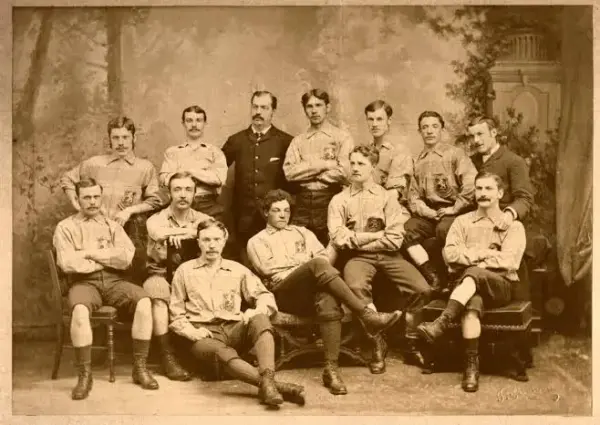
Paul Schrader said of writing the Taxi Driver script that it jumped out of him like an animal. The Corinthian was similar. Without sounding wanky, it was as if Andrew Watson was breathing into my ear across time. Now, in my writing I have very little interest in portraying heroes or victims. I want real people who are flawed and, in many cases, unlikable. Writing a story about a real figure from history would prove to be tricky. I knew I had very little interest in telling a “true story.” As far as we know, Peter Watson (Andrew’s father) was dead by the time Andrew played for Scotland. In my play, he is still alive. Hannah Rose (Andrew’s mother) did not travel to Scotland with Peter and Andrew. In my play, she does. My Andrew is at times proud, defiant, and perhaps someone you do not always want to be around. His story must speak to the past and the present, and that’s what I set out to achieve.
So, we are a few months out from rehearsals and the script is in decent enough shape, then it was time to find a director. When Brian came to me and said Martin McCormick was going to direct the piece, I was so, so thrilled. I’ve known Martin since we were both a part of The Traverse 50. He co-wrote and directed two excellent football plays, The Celtic Story and Oh When the Saints, and he also wrote one of the best plays I’ve ever seen, Squash. He is like me in many ways. He hails from Drumchapel and is expected to write a certain way. I hail from Maryhill and am expected to write a certain way. But we both defy conventions.
Being in the rehearsal room with Martin has been something of a revelation. He is one of few directors I’d ever let tweak my dialogue. I know how good a writer he is—if a line I’ve written isn’t quite working, I know he will fix it and then some. He has my complete trust.
Casting the role of Andrew Watson was always going to prove somewhat difficult. We do not have enough actors of colour in Scotland. I had a few actors in mind. Luckily, Dayton Mungai was one of them. He is an exceptional young actor who we will all be talking about years from now. He has brought absolute fire into the rehearsal room. I am blown away by him.
I am very, very happy to return to A Play, A Pie and A Pint. The last play I wrote for them was Alföld. A tale of an interracial couple traveling through The Great Hungarian Plain who encounter a strange local who proposes that the wife of the couple travels home with him and pretends to be his fiancée. It was an odd, dark, and difficult play. I made a great friend from that play in Sam Stopford, one of the finest actors we have, and the piece did resonate with audiences.
And you’ll all be surprised to know that my next play is a musical that I am writing with the incredible, Malcolm MacFarlane.

Dayton Mungai
As for The Corinthian, I wrote this play when I went looking for a cheery, uplifting football story and somehow found something much more complicated, painful, and beautiful instead. I wrote it for my beautiful wife, Virág, and my beautiful son, Atlas.
I hope when people leave the theatre, they feel that same complicated mix I do: the joy of the game of football, the torture of not fully belonging, and that small, stubborn refusal to disappear when it would be more convenient to do so.
I hope they remember Andrew’s name when they emerge into that bright Glasgow sunshine from the Öran Mór.
I hope The Corinthian can do Andrew Watson some justice.
Tickets for The Corinthian here: The Corinthian – A Play, a Pie and a Pint
GO HERE TO SUPPORT US

‘He hails from Drumchapel and is expected to write in a certain way.’
What is this ‘certain way’ he is expected to write ?
Expected by whom ?
I’m glad these stories are being told, although finding documentation on some will be hard. I think I learnt about Andrew Watson from BBC Scotland some decades past. And you cannot really fake footballing ability, notwithstanding Dougie Donnelly’s postage-stamp penalty exploit at Hampden, so unfair discrimination risks decisive blowback.
In a documentary about other Corinthian champions currently on BBC iPlayer:
“The incredible real-life story of the original rebel girls of football, Corinthians Ladies FC from Manchester, who defied the English Football Association’s 50-year ban on women playing to become global champions.”
the surviving players mention playing against (and thrashing) a Scottish team called West Fife Dynamite, whose story is practically invisible to web search, although at least one newsprint photograph remains:
https://iconic.newsprints.co.uk/20035916-a-team-picture-of-the-women-s-football-teams-of-west-fife-dynamite-and-hoovereites-atredford-barracks-in-edinburgh/
Their story would make a different kind of play, more of a collective, I guess. Perhaps a tragic chorus.
The FA’S ’50 year ban on women playing.’
Women were never banned from playing. The FA banned them from using facilities of clubs affiliated to the FA. That was undoubtedly a nasty and spiteful action. However, women could have organized and continued playing. Mostly, they did not.
@florian albert, if you’d watched the BBC documentary it would have spelt out the difficulties that women faced in playing under the FA’s ban:
https://www.bbc.co.uk/iplayer/episode/m002wnjw/the-corinthians-we-were-the-champions
how their triumphs and tribulations were suppressed, what a contrast they faced when playing in stadiums abroad, and what additional enforcement the English FA imposed to stop women playing (like striking off or suspending officials involved in women’s football, the FA page gives an example from Kent in 1947). Obviously the English FA set the tone domestically and through influence abroad (including Scotland). Women players were commonly banned from even using changing and washing facilities.
To continue the quote from the documentary’s blurb:
“While women were banned from playing on any official football pitches in England from 1921 to 1971, the Corinthians found fame in top stadiums around the world. Beating Germany to an unofficial European Cup in 1957, and winning what the press dubbed an unofficial ‘World Cup for women’ in 1960, they were one of the most successful women’s teams the UK ever had. Yet, for decades, their world-beating triumphs were forgotten.”
Obviously the ban achieved something the FA intended, while social pressure, lack of resources (for working class girls especially, see the documentary on football boots), entrenched misogyny, a hostile and disparaging media, and a fading memory of the glory days of pre-ban women’s football (which was highly popular) contributed as well.