
We’re All NIMBYs Now
“No one wants a data centre in their backyard” is a truism, if ever one was spoken: residents in US states that live near hyperscale AI data centres testify to the impacts locally from noise, data centre water use, air pollution from generators, spiking electricity prices, and the huge areas of green field and agricultural land transformed to industrial facilities.
However this phrase, that could be considered a NIMY response to development, wasn’t spoken by a protester or a local resident close to a data centre; it was Microsoft’s own lawyer Lindi Stone
speaking at a webinar for lawyers.
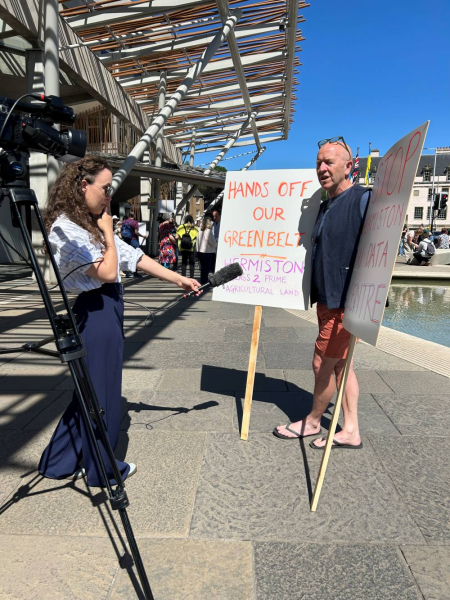
This week groups campaigning against hyperscale AI data centres in Scotland gathered outside Holyrood to make their voices heard to decision makers (see below). It coincided with Climate Action and Rural Affairs parliamentary questions where three MSPs had lodged questions on hyperscale data centres and which resulted in so many follow-up questions, that the Presiding Officer had to finish the session before they had all been asked.

Each one of these protesters came from a community where a hyperscale AI data centre is planned: Dunbar, Hermiston and the Gyle in Edinburgh, Larbert, Hunterston, Auchtertool, Bishopriggs, the AI growth zone at Chapelhall and Longformacus/Lammermuirs. One campaign, against the 550MW site at Hurlford, Ayrshire couldn’t attend in person but sent emails to MSPs inviting them to meet the campaigners.
These communities were all there because they see the immediate impacts on their own communities but they also are campaigning on the wider impacts for Scotland and globally. And one of these is accelerating climate emissions.
See also:
Eh? Aye? Resisting Scotland’s Hyperscale Data Centre Revolution by Mike Small
The AI Backlash Is Real. And It’s Winning by Ewan Morrison
We are experiencing a historic heat wave which is an alarm bell for the impacts climate change will have on Scotland and on the world. The energy use of hyperscale AI data centres is driving fossil fuel use across the world as data centres cannot get the energy they need from the grid. The first data centre consented under the national infrastructure regime in the UK is being built off-grid with an on-site gas-fired power station to provide the electricity for cooling. Energy bosses said that hundreds of connections for gas have been applied for by data centers waiting for a connection to the grid.
The questions in the Parliament saw MSPs across the political spectrum question the Cabinet secretary on the impacts hyperscale AI data centres would have on their constituents and on Scotland as a whole, and questioned what preparation and studies the Scottish government had done as this wave of hyperscale data centre applications comes in.
In response to the parliamentary questions we heard the minister say, again and again, they should be ‘in the right place’. But what is the right place for a planet-destroying development like a hyperscale AI data centre? Surely the right place is no place at all.
It is these local people who gathered at Holyrood who care deeply about their communities and their area who are at the forefront of this battle that is one for the very existence of a habitable planet.
Until the Scottish government comes to its senses and implements a moratorium while it starts to do the work of properly assessing the impacts and putting in place the governance and policies required, we are relying on local communities fighting each data centre one by one as it comes through the planning system, holding the line while the rest of us campaign to help the policies catch up.
Developers love to throw around the phrase NIMBY at campaigners but local people are usually the first responders when unsustainable development is proposed, as Norman Philip from the Larbet campaign said to Vicky Allen reporting for the Herald:
“I’m from Falkirk where the mega data centre has been proposed 500 meters from the local hospital. This is the same community that was faced with fracking and managed to… get it to the Scottish Government, where we got a moratorium.”
We, who care about environmental action in Scotland, and international action on climate change, owe a debt of gratitude to local campaigners for the huge amount of work it takes to oppose a planning application. 95% of planning applications are approved in Scotland and volunteers with no experience of planning go up against planning consultants, planning lawyers and people whose job it is to know everything about planning and the planning system through years of experience.
We are all NIMBYs now because a hyperscale AI data centre is not something that should be in anyone’s backyard. Our collective backyard is Planet Earth, our unique and fragile home. We all need to draw inspiration from these local campaigns who are seeing an existential threat to their communities and the places they love and fighting against it with all they’re worth. We need to see the existential threat of climate and ecological breakdown to our own planetary home and backyard and start to be NIMBYS for the planet.
If you want to get involved with a local campaign or start one where one doesn’t exist yet there is advice here.
If you have special knowledge as a planner, ecologist, hydrologist, power engineer, AI expert, and can help local communities please get in touch with me [email protected]
More info on how to engage with the planning system and oppose planning applications for hyperscale ai data centres is here.
We nearly have the funding raised to employ a full time planner to assist local communities in fighting each data centre application by application. If you would like to contribute to this you can do so here.

We are supported only by our readers. We don't have corporate backers and we don't take advertising, so we rely entirely on your support.
Help to support independent Scottish journalism
“Surely the right place is no place at all” is a genuinely staggering statement that would have human beings still cowering from lions in caves if our ancestors had believed it. It’s not a sensible argument or policy. It reduces what should be a sensible debate into a phoney and self serving binary choice: either you agree that digital infrastructure should not exist, or you’re an enemy of the planet. That’s left wing Trumpism.
Given this week’s temperatures no one should doubt the climate crisis is real but the jump from “approve a data centre in Larbert” to “existential threat to the planet” requires considerably more thinking than this piece does. The article does have an interesting statistic about 21% of uIrish electricity consumption going to data centres. But the answer to that is developing a proper national energy plan, cumulative impact assessments, and grid investment. A blanket ban proposed would treat every application as *equally evil* regardless of scale, location, or energy source. I guess that’s the point though – easier to spread fear across the nation to get a planning denial in your patch.
Similar to an earlier article on this site what’s missing is an honest assessment of opportunity costs. Scotland’s digital economy runs on infrastructure including serices we all need like the NHS, police, and government iteself. All of it depends on data being processed somewhere. Bannning every data centre in Scotland doesn’t make that demand disappear. It just means the servers end up somewhere with weaker environmental standards and less renewable energy than we have.
Local communities deserve proper consultation, environmental assessment, and transparency. That’s a fair ask. But Scotland also needs investment, infrastructure and the ability to live and compete in the modern world. A ban would set us all back in the interests of a middle class green minority.
This is sophistry. Community campaigners are neither calling for a ‘blanket ban’ on digital infrastructure nor arguing that it should not exist. What they are calling for is a moratorium on the approval of hyperscale datacentres until such time as the Scottish Government puts a proper policy framework in place against which individual proposals can be properly assessed. It is the failure of Scottish Ministers to do that – despite repeated warnings – that has led to the current speculative feeding frenzy.
PS: There is no ‘Energy Gap’. That’s another fallacy.
Good article I agree “no place is the right place”. Today I was offered 100gb of cloud by Microsoft and for what? Microsoft 365? Sort of, but really it’s just about money – the transfer of money from ordinary folk to big rich guys. I had a look the other day and my Hotmail emails stretched back to the 1990s – on two accounts. – do I need them? How many of us have that stuff hanging around burning up the earth?
I don’t use social media but I assume it eats up a lot of data too – is it needed? I mean really needed, just so we can have a quick one or two line barny with some stranger or other a couple of times a day? And usually just over some passing media fancy like who’s going to be on Strictly? Or bake off? How did we all get along without these things?
And really, isn’t it just another way for the Zuckerbergs and Musks to make money and dangerously gain influence including over public discourse and indeed our politics?
Entertainment over the internet, such as Netflix – that one seems to be at the top of the pile – but would anyone really miss a collection of channels such as those UKTV offers? Is the ultimate achievement of humankind the creation of TV channels such as Dave? No offence.
Most of our digital revolution is junk and it’s killing the planet. The rest is generally negativity, dome bullying, and porn. And also weird stuff, I believe. Next it’ll be AI and all the crap it brings with it – more people making dirty pictures I suppose along with huge energy consumption.
Save the planet, reduce your data usage if you can’t turn it off.
Good article but this reply is spot on too, “most of our digital revolution is junk and it’s killing the planet”, time to collectively wake up.
That’s true ‘we need giant datacentres to make AI slop and play Tetris’
Imho we don’t need ANY of those structures!!! It’s driven by greed and to be honest AI, apart from perhaps in the Medical field, is not the great future… It’s being hyped and people are being gaslit by govt to “embrace AI” .. in simplified terms, forget AI, people should get off their phones and laptops, as it is a big factor in the dumbing down of society, people need to remember how to function without phones, computers etc and return to basic ways, as for the AI centres being planned, people don’t want them! They are unwanted, they will ruin communities without bringing anything tangible, in way of employment etc to the areas…how about this! Why don’t the ai companies compensate the affected communities financially, give a huge payout to every person, family, community who will be impacted by the building of the data centres… And the Scottish govt seems to be ignoring the issues surrounding the centres…. I really hope the bubble bursts soon and AI is consigned to the rubbish bin…call me a luddite, I don’t care!!!!
Scotland has A. Lots of empty land and bodies of water with low levels of life.
B. Scotland produces more power than it uses.
C. Scotland has lots and lots of water.
Why not allow data centres to be built where few people live. They could be built on lochs alongside solar farms for efficiency. Water sited solar farms already exist in the far east, and are more productive than land based.
They do NOT use lots of water, but recycle. The pits washed millions of tonnes of coal every year by recycling water, and data centres are CLEAN, unlike coal.
Scotland struggles to raise local taxes, and these would be cash cows.
Obviously this needs a policy decision, then proper regulation, not more pearl clutches screeches.
Data centres owned by huge US corporate interests will only be “cash cows” to their owners. Like the gold rushes here in my NZ home, the benefits were meagre and temporary but they built mansions in the UK. Data centres will be even worse as they only employ about 40 people each, 6-7 MW power per job, at least gold mining did provide some employment for a while.
Spoiler: Scotland’s lochs are full of very valuable life. Why we should turn them over to American tech bros to build a global dystopia is quite beyond me.
If we have to have data centres why not locate them in abandoned mines? It would take some amount of funding to make the mines safe enough but they would be cooled as much by their environment and the noise produced would surely be less?
The World got along just fine without ChatGPT, with just the same amount of data. If that’s progress, I’m the Pope. But I have a feeling that the Scottish government will say that computerised cross-referenced filing systems are of National Importance. If anything, politicians are ideal candidates for replacement by AI.
I think that Westminster has already informally agreed to sell of large areas of Scotland to major corporations for purposes that we are only slowly becoming aware of. We don’t need Nuclear energy, this is for England’s benefit not ours. We don’t need Data centres, again, this is for Westminster’s benefit not ours. Holyrood does not have sufficient power to block Westminster as most things seem to be “reserved matters”. These are all reasons why we urgently need Independence. The longer it takes to achieve that the more we will need to “repair” the damage done to the country.
Well said